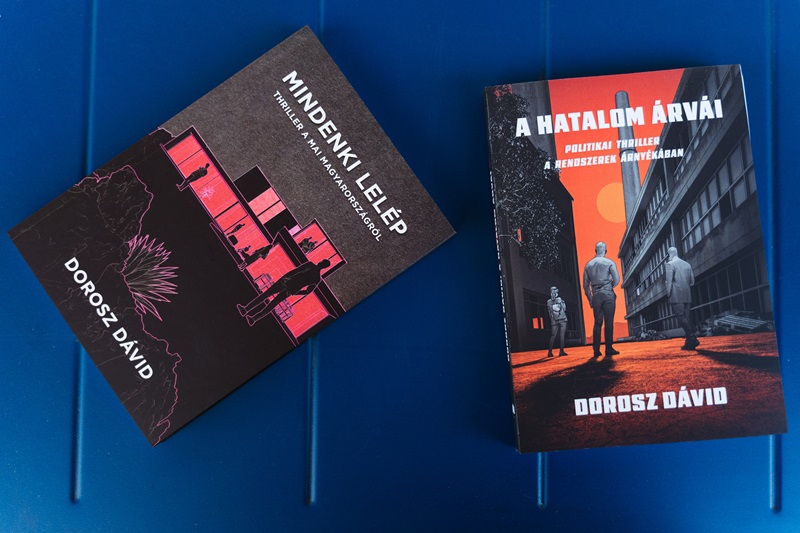
Having swapped the political arena for the writer’s desk in recent years, Dávid Dorosz dives into Hungarian reality where it hurts most with his new novel. Where The Orphans Of The Power Die is a tense political thriller, “an indictment of the NER”, and it eerily echoes the child-protection scandals of recent years with unsettling precision. Where do the inside stories about “the filthiest parts of the system” come from? Why do we feel like abandoned orphans in our own country? And why does Dorosz believe he has to write even for those who currently cannot? We spoke to the author in Budapest about insider sources, the steady drift towards radicalisation, the possibility of social peace, and the forthcoming film adaptation of his previous work, We All Leave.
Szol24: We did our last interview about your previous book, We All Leave, last August, and you mentioned then that you were already working on your next book. Readers may get the sense that you were thinking on a much larger scale this time with Where The Orphans Of The Power Die. How different was the writing process?
David Dorosz: When We All Leave came out last year, a significant part of this book was already finished. The wonderful feedback from readers helped a great deal, as did the fact that a lot of people approached me who I could use as sources: I’m mainly thinking of people working inside the NER, who gave me insight into the filthiest parts of the system.
This novel is also a kind of indictment of the NER. The title was inspired by the idea that the wounds we receive from power have, in effect, made us all orphans — those of us living in this country. We’ve been left to fend for ourselves, abandoned at the roadside by power. What interested me was how much power is present in the upbringing, careers and romantic relationships of my three protagonists.
At the launch, Ott Anna already mentioned how frighteningly topical this book has become — whether one thinks of the pardon scandal that broke in 2024 or the even more recent Szőlő Street case. How deeply did you immerse yourself in this subject? What was the research like in the social care world and in child protection?
There were several parts to the research. One was the more traditional kind, focusing on the past 40 years, since the main part of the story begins in 1989. That involved a great deal of library research, reading and interviewing people who were active at the time. The other half of the research was even more exciting: conversations with people actively working at different levels of the system. My aim was to depict and portray the NER as authentically as possible in this small-town setting….
Continued on the Szol24 website.